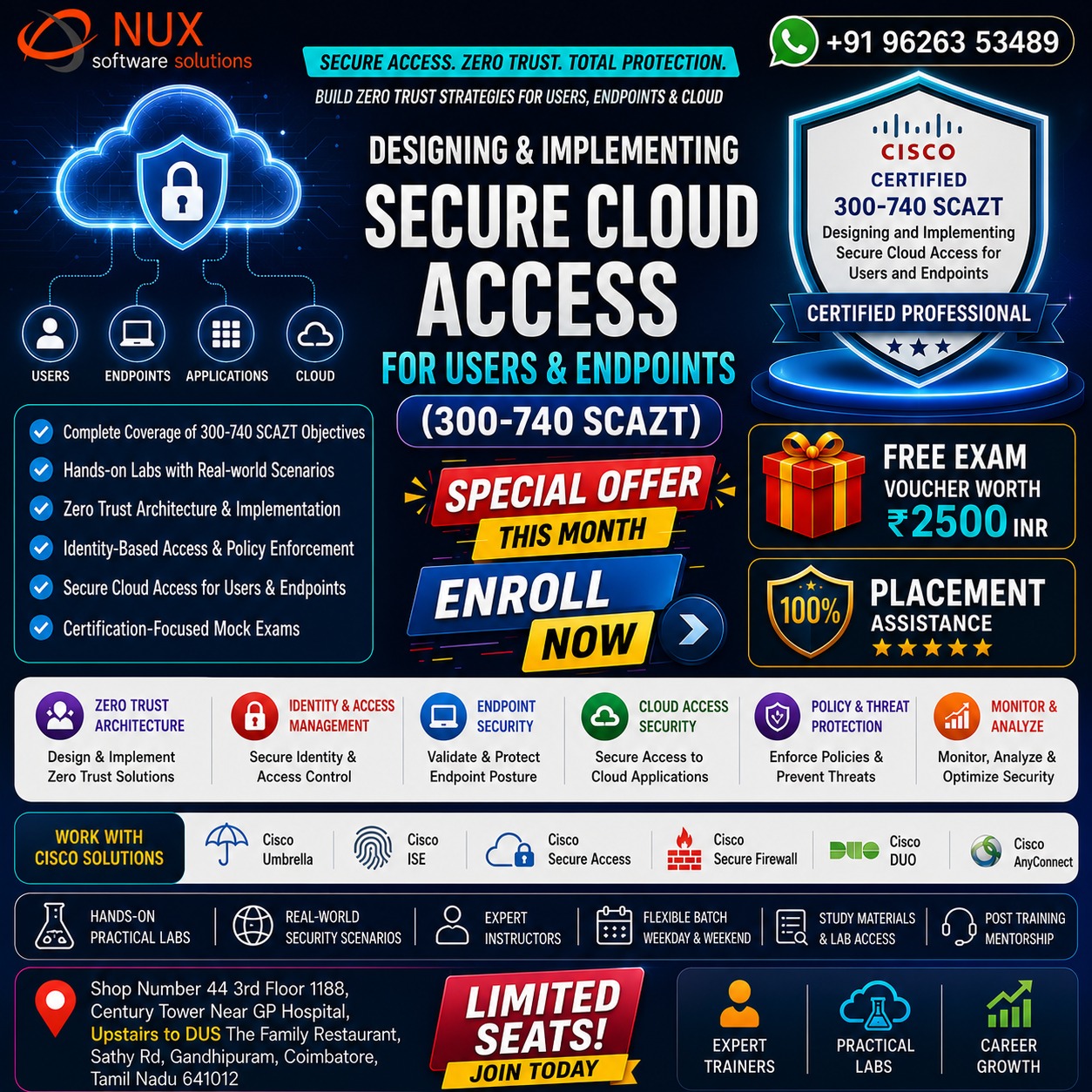
Designing and Implementing Secure Cloud Access for Users and Endpoints 300-740 SCAZT
Course Overview

The Designing and Implementing Secure Cloud Access for Users and Endpoints (300-740 SCAZT) training and certification program is designed for security engineers, network security professionals, cloud security specialists, SOC analysts, and IT administrators who want to build advanced expertise in Zero Trust security architecture and secure cloud-delivered access.

This certification validates your ability to design, deploy, configure, and manage secure access solutions for users, devices, applications, and workloads using modern Zero Trust principles and Cisco security technologies. The course focuses on identity-driven access, endpoint posture validation, secure web access, cloud security, policy enforcement, and threat protection.

Offered by Linux Training Center, Coimbatore, this course aligns with the official Cisco 300-740 SCAZT exam objectives and provides hands-on practical training in Zero Trust architecture, secure access policies, cloud-delivered security, and enterprise access protection.


Who Should Enroll?

  • Security engineers
  • Network security administrators
  • Cloud security engineers
  • SOC analysts
  • Security architects
  • IT professionals pursuing Cisco security certifications
  • Professionals preparing for advanced Zero Trust security roles

Why This Course Stands Out

  • Complete coverage of Cisco 300-740 SCAZT exam objectives
  • Hands-on labs with real-world Zero Trust security scenarios
  • Practical training in secure cloud access and policy enforcement
  • Strong focus on identity-based access control and endpoint security
  • Real-world enterprise security use cases
  • Certification-focused mock exams and assessments
  • Industry-aligned curriculum for modern cloud security roles

Career Roles You Can Pursue

  • Cloud Security Engineer
  • Security Engineer
  • Zero Trust Architect
  • Network Security Engineer
  • Security Operations Analyst
  • Security Consultant
  • Identity Security Specialist
  • Cybersecurity Engineer

Why Choose Linux Training Center, Coimbatore?

  • Expert instructors with cybersecurity and cloud security expertise
  • Advanced practical labs with enterprise security scenarios
  • Flexible weekday and weekend batch schedules
  • Comprehensive study materials and lab access
  • Mock exams and certification-focused preparation
  • Career guidance and placement assistance
  • Post-training mentorship until certification completion

Become a Zero Trust Security Expert

Advance your cybersecurity career with Cisco 300-740 SCAZT certification training. Gain practical expertise in Zero Trust architecture, secure user access, endpoint protection, and cloud security to excel in modern enterprise cybersecurity and cloud security environments.

Modules

Cloud Security Architecture
  • Describe the components of the Cisco Security Reference Architecture
  • Threat intelligence
  • Security operations toolset
  • User/device security
  • Network security: cloud edge and on-premises
  • Workload, application, and data security
  • Describe use cases and the recommended capabilities within an integrated architecture
  • Common identity
  • Converged multicloud policy
  • SASE integrations
  • Zero-trust network access
  • Describe industry security frameworks such as NIST, CISA, and DISA
  • Describe the SAFE architectural framework
  • Describe the SAFE Key structure
  • Places in the Network
  • Secure Domains
  • User and Device Security
  • Implement user and device authentication via identity certificates
  • Implement multifactor authentication for users and devices
  • Implement endpoint posture policies for user access to resources
  • Configure SAML/SSO and OIDC using an identity provider connection
  • Configure user and device trust using SAML authentication for a mobile or web application
  • Network and Cloud Security
  • Determine security policies for endpoints to control access to cloud applications
  • URL filtering (web layer and DNS layer)
  • Advanced app control
  • Network protocol blocking such as FTP and bit torrent
  • Direct-internet-access for trusted business applications
  • Web application firewall
  • Reverse proxy
  • Determine security policies for endpoints to control access to SaaS applications such as Office 365, Workday, and Salesforce
  • Determine security policies for remote users using VPN or application-based
  • Determine security policies for network security edge to enforce application policy
  • Security services edge
  • Cisco Secure Firewall (FTD and ASA)
  • Application and Data Security
  • Describe the MITRE ATT&CK framework and attacker defense mitigation techniques
  • Describe cloud security attack tactics and mitigation strategies
  • Describe how web application firewalls protect against DDoS attacks
  • Determine security policies for application enforcement using Cisco Secure Workload and enforcement agents
  • Lateral movement prevention
  • Microsegmentation
  • Determine cloud (hybrid and multicloud) platform security policies based on application connectivity requirements (third- party providers such as AWS, Azure, and Google Cloud)
  • Visibility and Assurance
  • Describe the Cisco XDR solution
  • Describe use cases for visibility and assurance automation
  • Describe benefits and capabilities of visibility and logging tools such as SIEM, Open Telemetry, and Cisco Secure Network Analytics
  • Validate traffic flow and telemetry reports for baseline and compliance behavior analysis
  • Diagnose issues with user application and workload access
  • Cisco Secure Network Analytics
  • Cisco Secure Cloud Analytics
  • Cisco Secure Cloud Insights
  • Cisco Secure Analytics and Logging
  • Verify user access to applications and data using tools (firewall logs, Duo, Umbrella, and Cisco Secure Workload)
  • Analyze application dependencies using tools such as firewall logs and Cisco Secure Workload
  • Threat Response
  • Describe use cases for response automation
  • Determine actions based on telemetry reports
  • Determine policies based on security audit reports
  • Determine action based on user or application compromise
  • Contain
  • Report
  • Remediate
  • Reinstantiate