
Conducting Threat Hunting and Defending using Cisco Technologies for Cybersecurity 300-220 CBRTHD

Course Overview

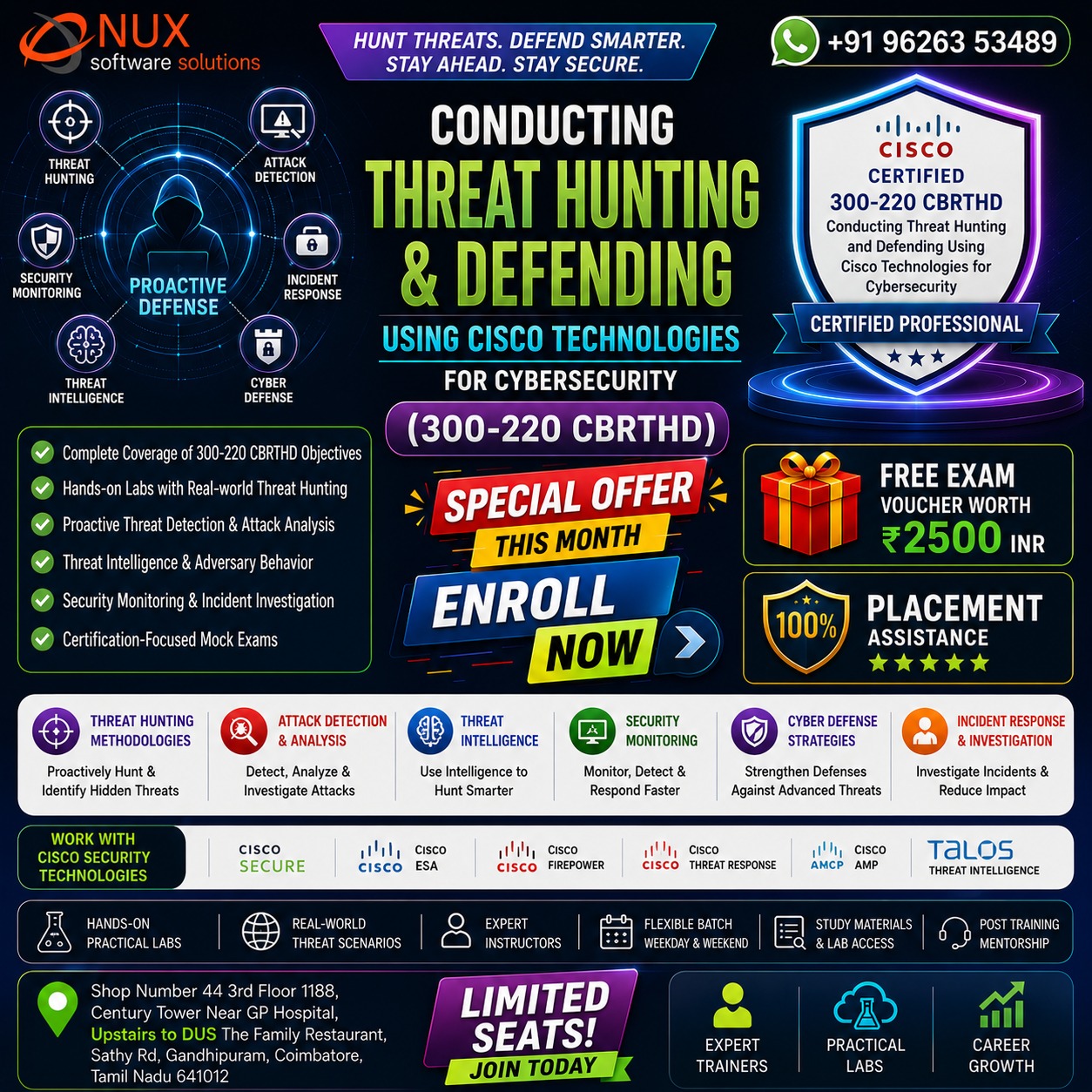
The Conducting Threat Hunting and Defending Using Cisco Technologies for Cybersecurity (300-220 CBRTHD) training and certification program is designed for cybersecurity analysts, threat hunters, SOC professionals, security engineers, and incident responders who want to build advanced expertise in proactive threat hunting, attack detection, cyber defense, and security operations using Cisco security technologies.

This certification validates your ability to proactively identify threats, detect malicious activities, analyze attacker behavior, investigate indicators of compromise, and strengthen organizational defenses against advanced cyber threats. The course focuses on threat hunting methodologies, detection engineering, attack analysis, threat intelligence, and defensive security operations.

Offered by Linux Training Center, Coimbatore, this course aligns with the official Cisco 300-220 CBRTHD exam objectives and provides hands-on practical training in threat hunting, security monitoring, attack investigation, detection strategies, and cyber defense operations.


Who Should Enroll?

  • Threat hunters and SOC analysts
  • Cybersecurity analysts and security engineers
  • Incident response professionals
  • Security operations specialists
  • Threat intelligence analysts
  • IT professionals pursuing Cisco cybersecurity certifications
  • Professionals preparing for advanced threat hunting roles

Why This Course Stands Out

  • Complete coverage of Cisco 300-220 CBRTHD exam objectives
  • Hands-on labs with real-world threat hunting scenarios
  • Practical training in proactive attack detection and defense
  • Strong focus on threat intelligence and attacker behavior analysis
  • Real-world attack simulations and security investigations
  • Certification-focused mock exams and assessments
  • Industry-aligned curriculum for modern cyber defense roles

Career Roles You Can Pursue

  • Threat Hunter
  • Cybersecurity Analyst
  • SOC Analyst
  • Security Operations Engineer
  • Incident Response Analyst
  • Threat Intelligence Analyst
  • Security Engineer
  • Cyber Defense Specialist

Why Choose Linux Training Center, Coimbatore?

  • Expert instructors with cybersecurity and threat hunting expertise
  • Advanced practical labs with real-world cyber defense scenarios
  • Flexible weekday and weekend batch schedules
  • Comprehensive study materials and lab access
  • Mock exams and certification-focused preparation
  • Career guidance and placement assistance
  • Post-training mentorship until certification completion

Become a Threat Hunting Expert

Advance your cybersecurity career with Cisco 300-220 CBRTHD certification training. Gain practical expertise in proactive threat hunting, threat intelligence, attack detection, and cyber defense to excel in modern security operations and advanced cybersecurity roles.

Conducting Threat Hunting and Defending using Cisco Technologies for Cybersecurity 300-220 CBRTHD
Modules

Threat Hunting Fundamentals
  • Apply the Threat Hunting Maturity Model to an organization's environment, as it relates to the Pyramid of Pain
  • Describe threats and how to model them with standards such as MITRE ATT&CK, MITRE CAPEC, TaHiTI, and PASTA
  • Describe the limiting factors of detection tools for malware behavior, propagation, and detection
  • Describe the advantages and disadvantages of automation (such as artificial intelligence and machine learning) in the operation of a SOC
  • Determine differences in tactics, techniques, and procedures of an advanced persistent threat and threat actor using logs
  • Interpret a threat intelligence report and draw conclusions about a threat actor (known advanced persistent threat/commodity human-driven/commodity machine-driven)
  • tactics
  • techniques
  • procedures
  • Threat Modeling Techniques
  • Select the threat modeling approach for a given scenario
  • Use MITRE ATT&CK to model threats (tactics, techniques, and procedures or changes in tactics, techniques, and procedures)
  • Describe the uses of structured and unstructured threat hunting
  • Determine the priority level of attacks based on the Cyber Kill Chain and MITRE ATT&CK
  • Determine the priority level of attacks based on the MITRE CAPEC model
  • Perform threat intelligence handling: gathering, cataloging, utilizing, and removing
  • Threat Actor Attribution Techniques
  • Determine attack tactics, techniques, and procedures using logs
  • Interpret tactics, techniques and procedures of a given threat actor
  • Select the delivery method, payload, tactic, or timeline that indicates an authorized assessment or an attack (threat actor or penetration tester)
  • Determine usable artifacts for detection of advanced persistent threat actors at all levels of the Pyramid of Pain
  • tactics
  • techniques
  • procedures
  • Threat Hunting Techniques
  • Use scripting languages (such as Python and PowerShell) to augment detection or analytics
  • Perform a cloud-native threat hunt
  • Determine undetected threats using endpoint artifacts
  • Determine the C2C communications to and from infected hosts using endpoint applications, processes, and logs
  • Select suspicious activity using session and protocol data
  • Determine the stage of infection within C2 communications using traffic data
  • Select weakness in code using code-level analysis tools (such as PE Checker, BURP Suite, and SEM Grep)
  • Describe the analysis process for applications and operating systems used by IoT devices
  • Describe memory-resident attacks and how to perform analysis using memory-specific tools (such as Volatility)
  • Construct a signature for detection or analysis
  • Recognize the likelihood of attack by an attack vector within a given environment
  • Threat Hunting Processes
  • Describe the process to identify memory-resident attacks
  • Determine compromises by reverse engineering
  • Determine known and unknown gaps in detection
  • vulnerabilities
  • configuration errors
  • threats
  • Interpret data from memory-specific tools
  • Construct a runbook or playbook to address a detectable scenario
  • Recommend tools, configurations, detection, and deception techniques for a given scenario
  • Recommend attack remediation strategies based on the results of a threat assessment
  • Recommend changes to improve the effectiveness and efficiency of a threat hunt
  • Recommend security countermeasures and mitigations for identified risks
  • Threat Hunting Outcomes
  • Describe how multiproduct integration enhances data visibility within a product and accelerates analysis
  • Diagnose analytical gaps using threat hunting methodologies
  • Recommend a mitigation strategy to block C2 traffic
  • Recommend changes in hunt capability to advance to the next Threat Hunting Maturity Model phase
  • Recommend changes to a detection methodology to augment analytical and process gaps
  • Use presentation resources to convey findings and direct environmental change