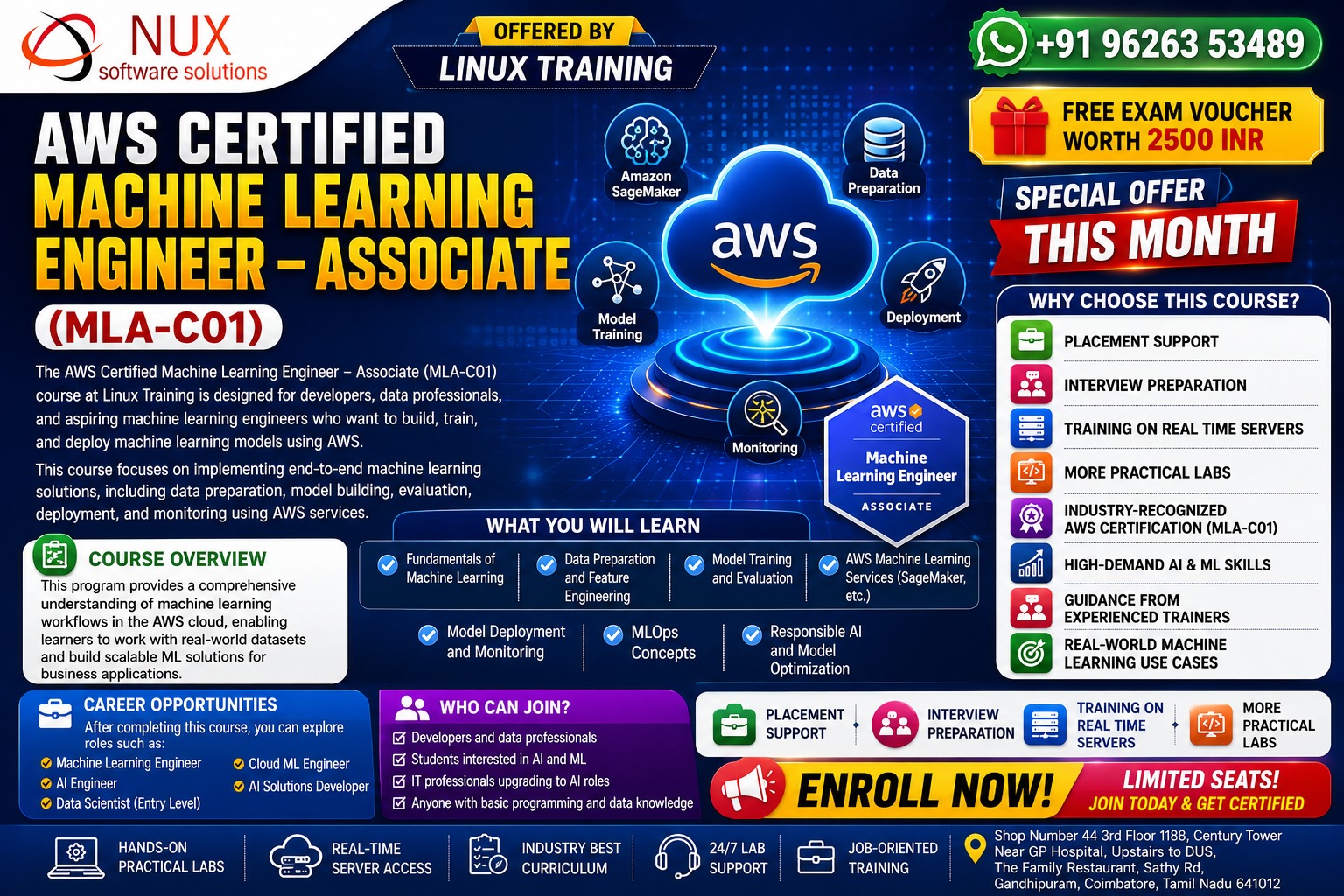
1. Data Preparation for Machine Learning (ML) - 28%
Ingest and store data
Data formats and ingestion mechanisms (for example, validated and non-validated formats, Apache Parquet, JSON, CSV, Apache ORC, Apache Avro, RecordIO)
How to use the core AWS data sources (for example, Amazon S3, Amazon EFS, Amazon FSx for NetApp ONTAP)
How to use AWS streaming data sources (for example, Amazon Kinesis, Apache Flink, Apache Kafka)
AWS storage options, including use cases and tradeoffs
Extracting data from storage (for example, Amazon S3, Amazon EBS, Amazon EFS, Amazon RDS, Amazon DynamoDB)
Choosing appropriate data formats (for example, Parquet, JSON, CSV, ORC)
Ingesting data into SageMaker Data Wrangler and Feature Store
Merging data from multiple sources
Troubleshooting ingestion and storage issues
Making storage decisions based on cost, performance, and structure
Transform data and perform feature engineering
Data cleaning and transformation techniques
Feature engineering techniques
Encoding techniques (for example, one-hot, label encoding, tokenization)
Tools for data transformation (Data Wrangler, Glue, DataBrew)
Services for streaming transformation (Lambda, Spark)
Data annotation and labeling services
Transforming data using AWS tools
Creating and managing features (Feature Store)
Validating and labeling data (Ground Truth, Mechanical Turk)
Ensure data integrity and prepare data for modeling
Pre-training bias metrics (for example, CI, DPL)
Strategies to address class imbalance
Techniques to encrypt data
Data classification, anonymization, masking
Compliance requirements (PII, PHI, residency)
Validating data quality (Glue DataBrew, Glue Data Quality)
Identifying and mitigating bias (SageMaker Clarify)
Preparing data for reduced bias (splitting, shuffling, augmentation)
Configuring data for training resources (EFS, FSx)
2. ML Model Development - 26%
Choose a modeling approach
Capabilities and uses of ML algorithms
Use AWS AI services (Translate, Transcribe, Rekognition, Bedrock)
Consider interpretability in model selection
SageMaker built-in algorithms
Assess data and feasibility of ML solutions
Select appropriate ML models or algorithms
Choose foundation models and templates
Select models based on cost
Select AI services for business needs
Train and refine models
Training elements (epoch, steps, batch size)
Methods to reduce training time
Factors influencing model size
Methods to improve performance
Regularization techniques
Hyperparameter tuning methods
Effects of hyperparameters
Integrating external models into SageMaker
Using built-in algorithms and ML libraries
Using SageMaker script mode
Fine-tuning pre-trained models
Performing hyperparameter tuning (AMT)
Preventing overfitting and underfitting
Combining models (ensembling, boosting)
Reducing model size
Managing model versions (Model Registry)
Analyze model performance
Evaluation metrics (accuracy, precision, recall, RMSE, ROC, AUC)
Performance baselines
Identify overfitting and underfitting
Metrics in SageMaker Clarify
Convergence issues
Selecting and interpreting metrics
Assessing tradeoffs between performance and cost
Running reproducible experiments
Comparing shadow vs production models
Using Clarify for interpretation
Using Model Debugger
3. Deployment and Orchestration of ML Workflows - 22%
Select deployment infrastructure
Deployment best practices
AWS deployment services (SageMaker)
Real-time and batch inference methods
Provision compute resources (CPU, GPU)
Endpoint types (serverless, real-time, async, batch)
Choose containers
Optimize edge deployments (Neo)
Evaluate performance, cost, latency
Choose compute environments
Select deployment orchestrators
Select deployment targets (ECS, EKS, Lambda)
Choose deployment strategies
Create and script infrastructure
On-demand vs provisioned resources
Scaling policies comparison
IaC tools (CloudFormation, CDK)
Containerization concepts
Endpoint auto scaling
Enable scalable ML solutions
Automate provisioning
Build and maintain containers
Configure endpoints in VPC
Deploy models using SDK
Select metrics for auto scaling
CI/CD pipelines
AWS CodePipeline, CodeBuild, CodeDeploy
Automation with orchestration services
Version control (Git)
CI/CD principles
Deployment strategies (blue/green, canary)
Configure CI/CD pipelines
Apply deployment workflows
Automate ML pipelines
Configure training and inference jobs
Create automated tests
Build retraining mechanisms
4. ML Solution Monitoring, Maintenance, and Security - 24%
Monitor model inference
Model drift
Monitor data quality and performance
Design monitoring systems
Use Model Monitor
Detect anomalies
Monitor distribution changes
Use A/B testing
Monitor and optimize infrastructure and costs
Performance metrics (utilization, throughput)
Monitoring tools (X-Ray, CloudWatch)
Use CloudTrail for logging
Instance type differences
Cost analysis tools
Cost tracking techniques
Use monitoring tools
Create dashboards
Monitor infrastructure
Rightsize instances
Resolve latency issues
Apply tagging strategies
Troubleshoot capacity issues
Optimize costs
Secure AWS resources
IAM roles, policies, groups
SageMaker security features
Network access controls
Security best practices for CI/CD
Configure least privilege access
Configure IAM roles and policies
Monitor and audit systems
Troubleshoot security issues
Build VPCs, subnets, security groups